ai-career-opportunity-assistant
🚀 AI Career Opportunity Assistant
An intelligent, workflow-driven system designed to automate the extraction, evaluation, and filtering of job and internship opportunities from email data using AI-based decision-making.
📌 Overview
In the modern job ecosystem, students and fresh graduates are exposed to a large volume of opportunity-related emails from multiple platforms. These emails are often unstructured, repetitive, and misaligned with individual preferences, making manual filtering inefficient and error-prone.
This project addresses the problem by developing an AI-powered automation pipeline that transforms raw email content into structured, actionable insights. The system not only identifies valid opportunities but also evaluates their relevance based on a personalized user profile.
🎯 Objective
- Automate the identification of job and internship opportunities from emails
- Extract structured data from unstructured content
- Evaluate opportunities based on user-specific criteria
- Reduce manual effort and improve decision-making efficiency
⚙️ System Architecture
The system follows a multi-stage pipeline:
Email Trigger → Validation → AI Agent 1 → Conditional Filtering → AI Agent 2 → Decision Engine → Google Sheets Storage
Each stage is designed to progressively refine raw input into meaningful output.
🧠 Core System Logic
🔹 Stage 1: Email Acquisition
The workflow is triggered using a Gmail integration, which continuously monitors incoming emails and captures their content for processing.
🔹 Stage 2: Input Validation
An initial validation layer ensures that empty or invalid emails are filtered out before entering the pipeline. This prevents unnecessary computation and API usage.
🔹 Stage 3: AI Agent 1 — Data Extraction
The first AI agent is responsible for analyzing raw email content and extracting structured job-related information.
Key Responsibilities:
- Detect whether the email contains a real job/internship opportunity
- Extract critical fields such as:
- Company name
- Role/title
- Salary or stipend
- Application link
- Deadline
- Source platform
Important Behavior:
- Ignores promotional, webinar, and non-relevant emails
- Avoids guessing missing values (returns null instead)
- Handles multiple opportunities by selecting the most relevant entries
🔹 Stage 4: Conditional Filtering
A logical condition evaluates whether the extracted content qualifies as a job or internship opportunity.
- If TRUE → proceeds to relevance evaluation
- If FALSE → filtered out from further processing
🔹 Stage 5: AI Agent 2 — Relevance Evaluation
The second AI agent performs personalized evaluation using a predefined user profile.
User Profile Includes:
- Preferred roles (e.g., Software Developer, Data Analyst)
- Minimum salary threshold (≥ 4 LPA for jobs)
- Graduation year and eligibility
Evaluation Logic:
- Rejects incomplete or unclear opportunities
- Applies salary constraints for job roles
- Accepts internships regardless of stipend (with role validation)
- Calculates a match score (0–100) based on alignment
🔹 Stage 6: Decision Engine
Based on the evaluation output:
- Relevant opportunities → stored in Selected dataset
- Non-relevant opportunities → stored in Rejected dataset
🔹 Stage 7: Data Storage
All processed data is stored in Google Sheets in a structured format, enabling easy tracking, filtering, and future analysis.
📸 System Implementation (Visual Evidence)
🔹 Workflow Implementation (n8n)
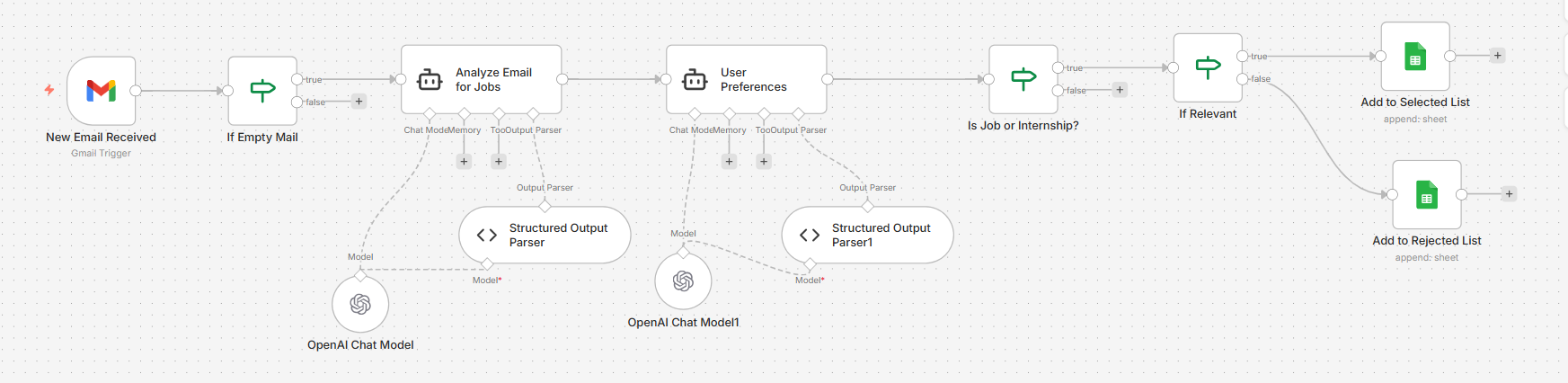
This represents the actual automation pipeline built using n8n. It illustrates the integration of triggers, AI agents, conditional nodes, and storage mechanisms into a unified system.
🔹 Workflow Logic Flowchart
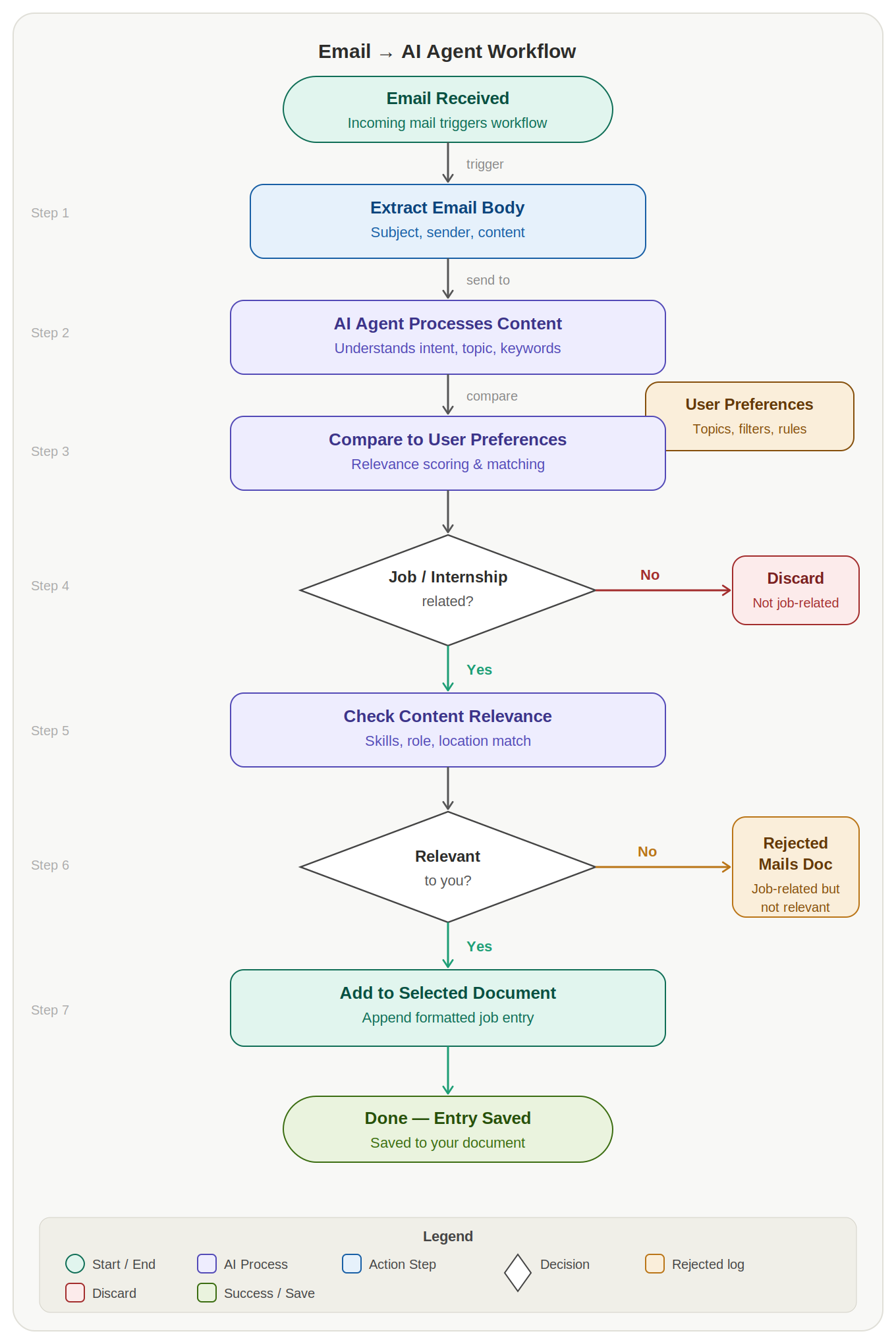
The flowchart provides a conceptual representation of the system logic, outlining how data moves through each stage of processing and decision-making.
🔹 Selected Opportunities Output
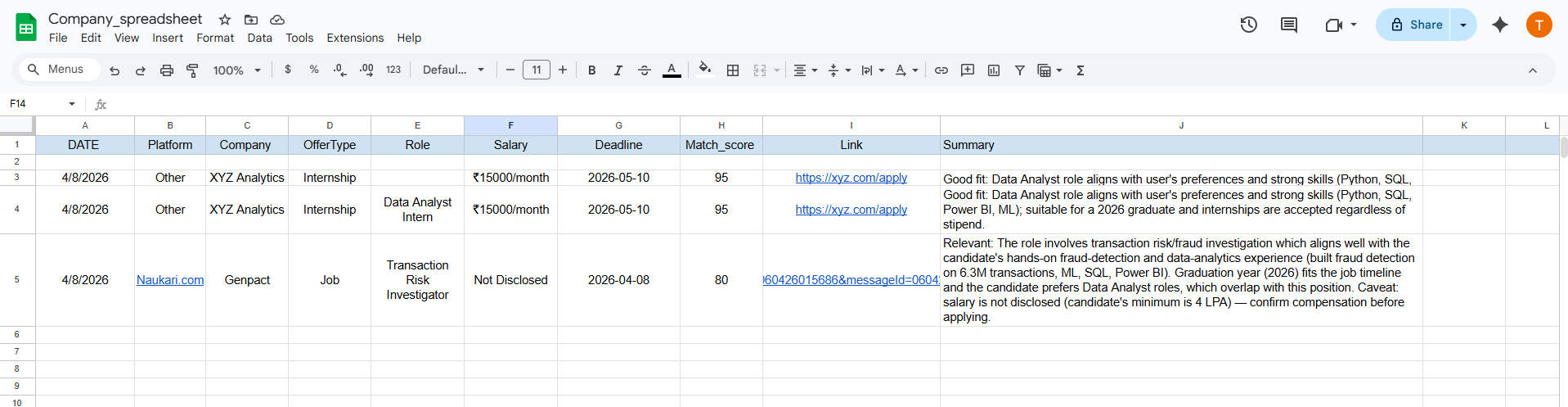
This dataset contains opportunities that meet the defined user criteria. Each entry includes structured attributes along with relevance indicators such as match score and decision status.
🔹 Rejected Opportunities Output
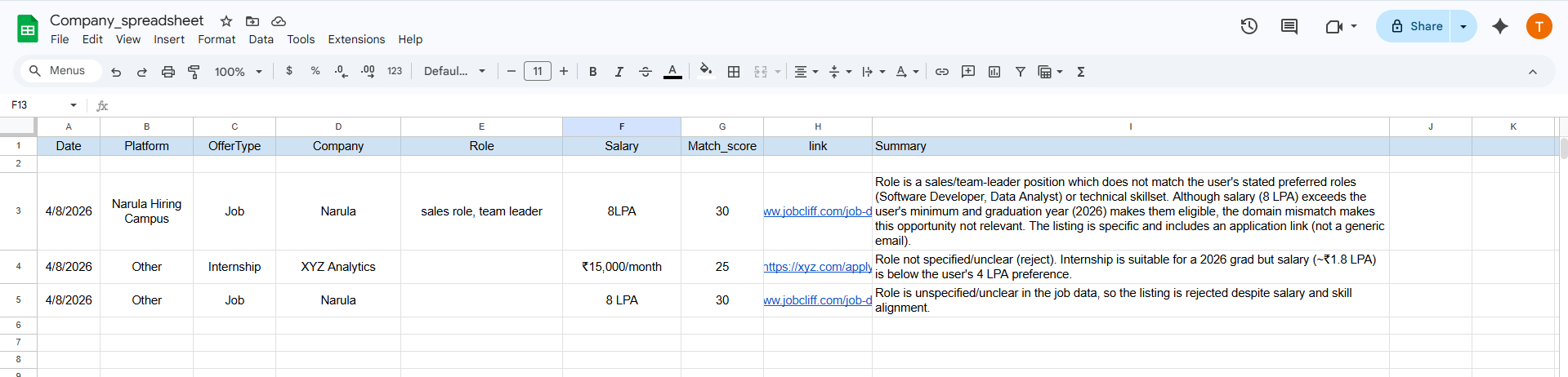
This dataset captures opportunities that were identified as job-related but did not satisfy the relevance conditions. Maintaining this dataset ensures transparency and traceability in decision-making.
🔹 Lean Canvas (Product Perspective)
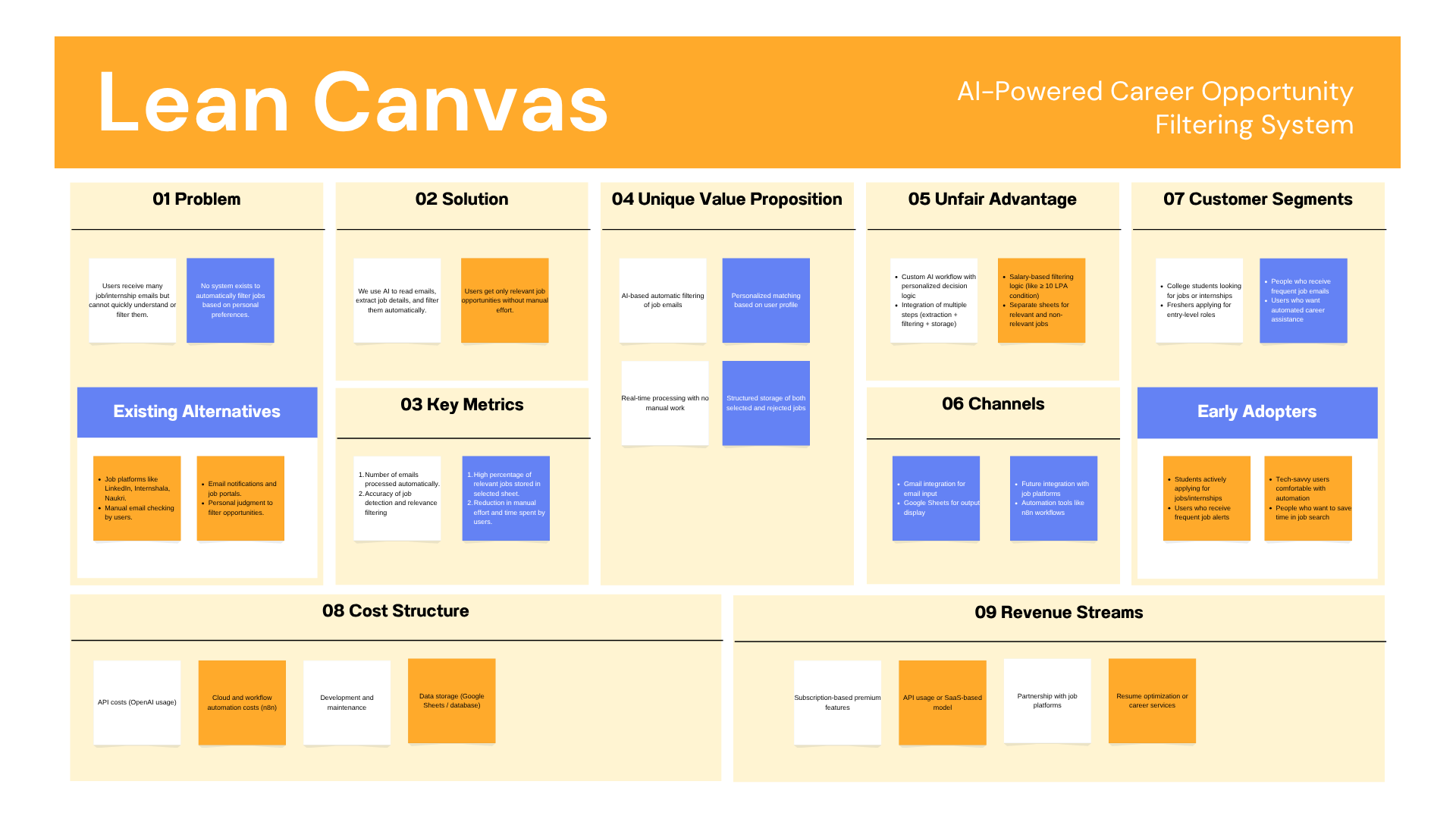
The lean canvas outlines the problem space, solution approach, user segments, and value proposition, reflecting the product thinking behind the system design.
🧪 Edge Case Handling
The system has been tested against multiple real-world scenarios to ensure robustness:
- Empty or missing email content
- Non-job and promotional emails
- Multiple opportunities within a single email
- Missing salary or deadline fields
- Low-salary job offers below threshold
- Role mismatch with user preferences
🛠️ Technology Stack
- n8n — Workflow automation platform
- OpenAI API — AI-based content analysis and decision-making
- Gmail Integration — Input data source
- Google Sheets — Structured data storage
📊 Results & Impact
- Successfully executed 100+ workflow runs for testing and validation
- Reduced manual effort in job filtering significantly
- Improved accuracy in identifying relevant opportunities
- Established a scalable pipeline for automated decision-making
⚠️ Limitations
- Performance depends on API availability and response quality
- Requires reasonably structured email content for optimal extraction
- Currently limited to email-based input sources
🔮 Future Scope
- Integration with job platforms such as LinkedIn and Internshala
- Resume-based dynamic personalization
- Dashboard for analytics and tracking
- Multi-user system with configurable preferences
👤 Author
Tripti Kumari
B.Tech Computer Science Engineering
Narula Institute of Technology
- 📧 Email: vishwakarmap1305@gmail.com
- 🔗 LinkedIn: https://www.linkedin.com/in/tripti-kumari-8b3abb253/
⭐ Final Note
This project demonstrates the practical application of AI and workflow automation in solving real-world problems. By combining structured data extraction with intelligent evaluation, the system transforms unorganized inputs into meaningful, decision-ready outputs.